
Productivity Management: Benefits, Tools & Employee Strategies in 2026

Table of contents
- What is productivity management?
- Understanding Productivity: Output Versus Input
- Why Productivity Management Is Critical in Modern Workplaces
- Importance and Benefits of Productivity Management
- How Employee Productivity Management Drives Business Success
- Popular Productivity Management Tools and Software
- Effective Methods to Measure and Enhance Productivity in the Workplace
- Productivity Management Techniques to Keep Your Teams Productive
- Productivity Management Challenges and How to Overcome Them
- Productivity Management vs Time Tracking: Key Differences
- Conclusion
- Frequently Asked Question
In today’s highly competitive and digital-first business environment, productivity is no longer a back-office concern. It is a leadership priority that directly impacts profitability, customer experience, and long-term growth. Organizations may have skilled teams and advanced tools, yet still struggle with delays, rework, and uneven performance if productivity is not managed systematically.
Productivity challenges have also evolved. Remote and hybrid work models, complex workflows, and constant digital interruptions make it harder to understand how work actually gets done. Traditional productivity assumptions, such as hours spent or visible activity, no longer reflect real contribution. This gap between effort and outcomes is where structured productivity management becomes critical.
Productivity management provides organizations with a clear, repeatable framework to understand how time, effort, and resources are converted into meaningful output. It helps leaders identify inefficiencies, improve focus, and align employee effort with business priorities. When applied consistently, productivity management improves efficiency, employee engagement, and operational predictability.
This guide explores productivity management in detail, including what it is, why it matters, and how organizations can use it to drive sustainable performance improvement.
What Is Productivity Management?
Productivity management is a structured approach that helps organizations plan, measure, and continuously improve how work is performed across teams. It focuses on maximizing value creation by ensuring that employee time and resources are used effectively and aligned with business objectives.
Unlike informal productivity tracking, productivity management is systematic and data-driven. It combines employee productivity management, productivity tracking, and performance measurement to provide visibility into how work flows through the organization. This visibility allows leaders to distinguish between high-value work and activities that consume time without contributing to outcomes.
At an organizational level, productivity management helps standardize expectations, reduce inefficiencies, and support better decision-making. At an employee level, it brings clarity around priorities, reduces overload, and encourages focus on meaningful tasks. For modern enterprises operating in distributed environments, productivity management creates accountability without relying on physical oversight.

Understanding Productivity: Output Versus Input
At the foundation of productivity management lies a simple but powerful principle:
Productivity = Output ÷ Input
Output represents the value delivered, such as completed tasks, resolved issues, or delivered projects. Input includes time, effort, and resources invested to produce that output. While the formula is straightforward, applying it effectively in real-world work environments requires nuance.
In knowledge-based roles, productivity is not purely about volume. Quality, accuracy, timeliness, and business impact are equally important. A developer who produces fewer features with higher stability may be more productive than one who delivers volume with frequent rework. Effective productivity management accounts for these differences rather than relying on simplistic metrics.
By consistently evaluating output relative to effort, organizations can establish realistic benchmarks, compare performance trends over time, and identify where improvements are needed. This output-focused approach shifts productivity conversations away from activity monitoring and toward measurable business value.
Why Productivity Management Is Critical in Modern Workplaces
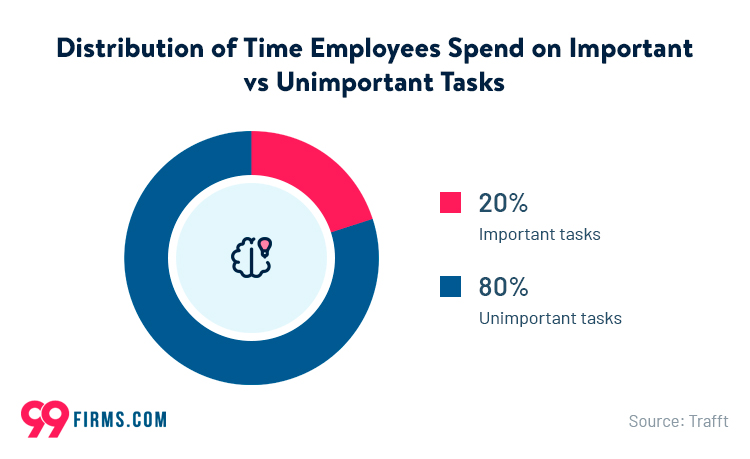
Workplace productivity today is influenced by far more than individual effort. Fragmented workflows, excessive meetings, constant notifications, and unclear priorities often reduce effectiveness even when teams appear busy. Without structured productivity management, these issues remain invisible.
Productivity management enables organizations to see where time is actually spent and whether that time contributes to outcomes. It highlights inefficiencies such as redundant processes, unnecessary coordination, or workload imbalances. These insights allow leaders to redesign workflows, rebalance capacity, and improve focus across teams.
For remote and hybrid teams, productivity management is especially important, as effective remote workforce management ensures visibility, accountability, and balanced performance across distributed employees. Managers cannot rely on physical presence as a proxy for performance. Instead, they need objective indicators that reflect real output and engagement. Productivity management provides this clarity while supporting fairness and transparency.
Importance and Benefits of Productivity Management
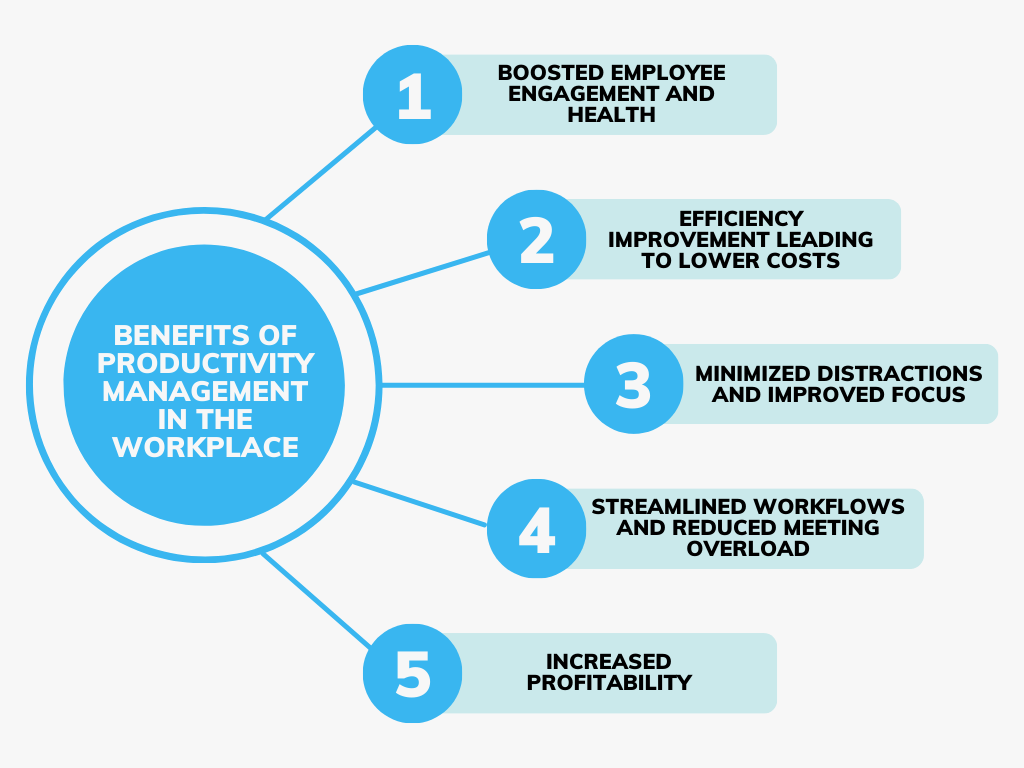
The benefits of productivity management extend across employees, teams, and the organization as a whole. When implemented correctly, productivity management creates a foundation for consistent execution and long-term growth.
Improved Employee Engagement and Well-being
Clear priorities and realistic workloads reduce stress and uncertainty. Productivity management helps employees understand what matters most and how their work contributes to broader goals. This clarity improves engagement and supports healthier work patterns, particularly in high-pressure digital environments.
Efficiency Improvement and Cost Optimization
Productivity management helps organizations identify wasted effort, duplicated work, and inefficient processes. By addressing these gaps, businesses improve efficiency while reducing operational costs. Efficiency improvement tools such as automation and workflow optimization further enhance this benefit by removing manual, low-value tasks.
Better Focus and Reduced Distractions
Distractions and frequent context switching significantly reduce workforce productivity. Productivity management introduces structure through task prioritization, workload planning, and focus-time allocation. Employees are better able to concentrate on high-impact work, improving both speed and quality of delivery.
Streamlined Workflows and Collaboration
Productivity management improves coordination by clarifying responsibilities and dependencies. Teams spend less time on unnecessary meetings and follow-ups, and more time on execution. Streamlined workflows improve collaboration and reduce delays caused by miscommunication or unclear ownership.
Predictable and Sustainable Business Performance
Organizations that manage productivity systematically are better equipped to scale. Productivity management supports predictable delivery, balanced workloads, and continuous improvement. Over time, these benefits translate into stronger financial performance, higher retention, and sustainable competitive advantage.
How Employee Productivity Management Drives Business Success
Effective employee productivity management directly influences how consistently organizations meet their business goals. When managers have visibility into how work is distributed and completed, they can align individual performance with team and organizational priorities. This alignment improves accountability while reducing friction caused by unclear expectations.
Data-driven productivity insights also enable better coaching. Managers can identify performance gaps early, support employees with targeted guidance, and recognize high performers objectively. Over time, structured employee productivity management improves workforce productivity, delivery predictability, and decision-making quality, helping organizations scale efficiently without increasing operational complexity.
Popular Productivity Management Tools and Software
Modern enterprises rely on productivity management software and productivity monitoring software to manage performance across distributed teams with real-time visibility and structured insights. These productivity management tools automate data collection related to time usage, task progress, and output quality, eliminating reliance on manual reporting.
Common capabilities include productivity tracking, task management software, utilization analytics, and performance dashboards. Automation enables leaders to detect inefficiencies, identify overload risks, and optimize workflows proactively. The right productivity management software ensures consistency, transparency, and scalability, especially in remote and hybrid work environments where visibility is otherwise limited.
Effective Methods to Measure and Enhance Productivity in the Workplace
Accurate productivity management depends on using multiple measurement methods rather than relying on a single metric.
Output-based measurement evaluates completed deliverables such as tasks, projects, or service requests over time. This method focuses on tangible outcomes and is especially effective for project-based and knowledge roles.
Time and utilization analysis examines how working hours are distributed across productive, neutral, and non-productive activities. Understanding utilization helps organizations balance workloads and prevent burnout without equating longer hours with higher productivity.
Quality and rework tracking ensures that productivity gains do not compromise standards. Measuring error rates, revisions, and rework highlights whether output is sustainable and reliable.
Trend-based performance measurement analyzes productivity over extended periods rather than isolated snapshots. Trends reveal systemic issues, seasonal variations, and improvement opportunities.
When combined, these performance measurement methods provide a balanced view of productivity and support continuous improvement using efficiency improvement tools.
Productivity Management Techniques to Keep Your Teams Productive
Effective productivity management techniques focus on structure, balance, and long-term sustainability.
Clear goal setting ensures employees understand priorities and success criteria. Well-defined goals reduce ambiguity and help employees focus on outcomes rather than activity.
Time management strategies such as prioritization frameworks and focus scheduling reduce distractions and improve execution quality. These strategies are essential for maintaining productivity in digital work environments.
Workload optimization distributes tasks realistically across teams, preventing overutilization and underutilization. Balanced workloads improve morale and consistency.
Employee engagement initiatives reinforce accountability and motivation. Engaged employees are more likely to manage time effectively and maintain productivity.
System-driven productivity management ensures consistency through standardized tracking, reporting, and analytics. This reduces bias and enables scalable workforce productivity improvement.
Productivity Management Challenges and How to Overcome Them
Despite its benefits, productivity management often faces resistance. Employees may perceive tracking as surveillance if objectives are not clearly communicated. Organizations also struggle when productivity data is misused or interpreted without context.
Another common challenge is tool fatigue, where too many systems create complexity rather than clarity. Short-term output obsession can also lead to burnout and declining quality.
These challenges are addressed by transparent communication, outcome-focused measurement, and responsible use of data. Productivity management should prioritize improvement and sustainability rather than control.
Productivity Management vs Time Tracking: Key Differences
Productivity management and time tracking are related but not identical. Time tracking focuses on recording hours worked, while productivity management evaluates how effectively those hours generate meaningful output.
Productivity management incorporates context, quality, and outcomes, making it a strategic capability rather than a tactical control mechanism. While employee time tracking software supports productivity management by capturing work-hour data accurately, it does not replace the broader strategic framework required for performance optimization.
Conclusion
Productivity management is no longer optional for organizations operating in competitive, digital-first environments. By combining structured measurement, the right tools, and employee-focused strategies, organizations can improve efficiency, engagement, and execution quality.
When productivity is managed proactively, businesses gain predictability, employees experience clarity, and performance improvements become sustainable rather than short-lived.
Also Read: 10 Simple Strategies To Improve Work Efficiency
Frequently Asked Question
Q1. Is there a benefit to implementing a productivity management system?
The use of a productivity management system assists in planning activities, measuring results, and reducing factors that hinder productivity. If all companies adopt a productivity management system, they will be able to improve efficiency in their time management, boost employee efficiency, and enhance the attainment of company objectives with good efficacy.
Q2. What’s the reason for the importance of productivity in any workplace?
The importance of productivity in any workplace should be stressed as it is a critical element to the profitability and the overall success of an organization. As productivity increases, the quality of work improves, and the cost of production and other resources is minimized, making productivity the most important controllable factor in the business strategy of any concern.
Q3. How does employee engagement affect productivity?
This impacts employees with lower stress levels, 18% higher productivity, and ultimately enhanced company profitability. This is a low engagement and, therefore, a substantial productivity drain or loss estimated at $8.8 trillion across the world.
How does productivity management support remote and hybrid workforces?
Productivity management supports remote and hybrid teams by providing objective visibility into output, workload distribution, and performance trends. It enables managers to maintain alignment, accountability, and fairness without relying on physical presence or constant supervision.
What KPIs should businesses track in a productivity management system?
Common productivity management KPIs include output per hour, utilization rates, task completion timelines, quality metrics, and workload balance. Together, these indicators help organizations evaluate efficiency, identify bottlenecks, and drive continuous performance improvement.
Can productivity management software integrate with HRMS, ERP, and payroll systems?
Yes. Most productivity management software integrates with HRMS, ERP, and payroll platforms through APIs, enabling centralized data flow, unified reporting, and better coordination between workforce analytics and operational systems.
How does productivity management help identify skill gaps and training needs?
Productivity management highlights recurring inefficiencies, delays, and quality issues through performance data. These insights help managers identify skill gaps accurately and design targeted training initiatives that improve employee capability and overall workforce productivity.
What security and compliance features should a productivity management tool provide?
A productivity management tool should include data encryption, role-based access controls, audit trails, and compliance with privacy regulations. These features ensure sensitive employee data is protected while maintaining transparency and organizational trust.
Learn how ProHance can help

Abhishek Tahlan
Abhishek is a marketing professional with more than 7 years of experience in the field of digital marketing. He has worked in various senior marketing roles across a wide variety of organizations and industries, including EdTech and Tech.
