




How to Prevent Hydrogen Cracking in Low-Alloy Steel Welds
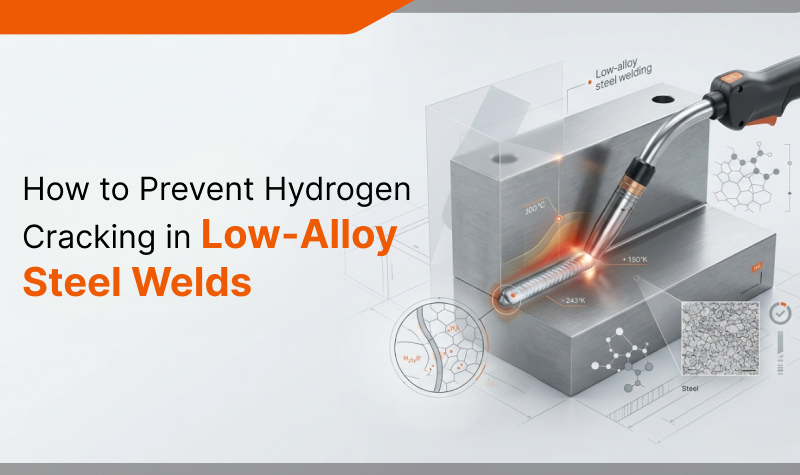
Cracking that develops after welding has finished is one of the most costly and frustrating challenges in metal joining. Welds may appear acceptable during inspection immediately after completion, yet fail hours or days later, once the component is in service or being handled. In low-alloy steels, this risk is higher due to how these materials respond to heat, cooling rates and residual stress. Hydrogen cracking remains a leading cause of delayed weld failure, particularly where process control is inconsistent or material preparation is overlooked.
Preventing hydrogen cracking requires attention across the entire welding cycle. From surface preparation and consumable handling to temperature control and post-weld practices, each stage influences whether a weld remains sound over time.
Understanding Hydrogen Cracking in Low-Alloy Steels
Hydrogen cracking occurs when diffusible hydrogen becomes trapped within the weld metal or heat-affected zone and combines with tensile stress and a susceptible microstructure. In low-alloy steels, rapid cooling can produce hard and brittle areas that restrict hydrogen movement. As hydrogen accumulates, internal pressure builds until cracking occurs.
Hydrogen cracking in welding is commonly associated with delayed cracking because it does not usually form during solidification. Instead, cracks may appear several hours after welding, often at ambient temperatures.
Conditions That Lead to Hydrogen Cracking
Hydrogen cracking does not occur randomly. Three conditions must exist together for cracks to form. Managing any one of these reduces the likelihood of failure.
- Diffusible hydrogen is introduced through consumables, moisture or surface contamination.
- Hard or brittle microstructures formed during rapid cooling.
- Tensile stresses caused by weld shrinkage, restraint or joint design.
Low-alloy steels often meet two of these conditions by default, making hydrogen control the critical variable during welding.
Material Selection and Surface Preparation
Effective prevention begins before the arc is struck. Low-alloy steels vary widely in composition and those with higher carbon equivalent values demand stricter welding control. Reviewing material specifications helps determine whether preheating and controlled cooling are needed.
Surface preparation directly affects hydrogen input. Moisture, oil, grease, rust and paint all decompose under heat and release hydrogen into the weld pool. Even minor contamination can be enough to initiate hydrogen-induced cracking in susceptible steels.
Before welding, joints should be:
- Cleaned thoroughly to remove oil, grease and residues.
- Free from rust, mill scale and coatings.
- Dry and protected from condensation during storage and fit-up.
Consistent preparation reduces variability and improves repeatability across welds.
Consumable Handling and Hydrogen Control
Low-hydrogen consumables are designed to limit hydrogen input, but their performance depends entirely on correct handling. Poor storage practices can allow moisture absorption, undermining their effectiveness.
Key control measures include:
- Storing electrodes in dry, temperature-controlled environments.
- Baking electrodes according to the manufacturer’s recommendations.
- Limiting exposure time after removal from holding ovens.
- Keeping fluxes and wires sealed until required.
Reliable consumable quality simplifies hydrogen management. Superon Technik supports consistent welding performance through controlled manufacturing processes and dependable availability, helping users maintain stable results across different sites and batches.
The Role of Preheating in Crack Prevention
Preheating is one of the most effective defences against hydrogen cracking in low-alloy steel welds. Raising the base metal temperature before welding slows the cooling rate and allows hydrogen to diffuse away from critical areas.
Benefits of correct preheating include:
- Reduced hardness in the heat-affected zone.
- Lower residual stress levels.
- Improved hydrogen escape before accumulation.
Preheat temperature depends on steel composition, thickness and joint restraint. Uniform heating is essential and temperatures should be monitored to ensure they remain within specified limits throughout welding.
Welding Parameters and Technique
The welding technique directly influences cooling behaviour and stress distribution. Excessively low heat input promotes rapid cooling and hard microstructures, while excessive heat input can introduce distortion and degrade mechanical properties.
Good practice for low-alloy steels includes:
- Select a heat input appropriate to the material’s thickness and composition.
- Maintaining stable arc conditions.
- Using stringer beads instead of wide weave patterns.
- Avoiding unnecessary arc strikes and abrupt stops.
Controlled welding reduces stress concentration and promotes more uniform microstructures, lowering crack susceptibility.
Interpass Temperature and Cooling Control
Interpass temperature control is as important as initial preheating. Allowing the joint to cool too much between passes can recreate conditions that promote hard zones and hydrogen entrapment.
Maintaining consistent interpass temperatures:
- Reduces thermal cycling severity.
- Helps control microstructure formation.
- Improves overall weld integrity.
After welding, slow and controlled cooling further reduces residual stress. Insulating the weld area may be beneficial for thicker sections or highly restrained joints.
Post-Weld Measures and Inspection
Even with good control during welding, hydrogen may still remain within the weld metal. Post-weld measures aim to minimise the risk of delayed cracking.
Common practices include:
- Holding the weld at a moderate temperature to allow hydrogen diffusion.
- Avoiding rapid exposure to cold environments immediately after welding.
- Scheduling inspections after sufficient time has passed for delayed cracking to develop.
Visual inspection should be supported by appropriate non-destructive testing where required, particularly for critical components.
Consistency as a Long-Term Safeguard
Hydrogen cracking is often linked to inconsistency rather than a single failure point. Variations in consumables, storage conditions or supply quality can introduce hidden risks into otherwise well-controlled welding procedures. This is where dependable sourcing becomes as important as correct technique.
Superon Technik supports this need through consistent-quality welding consumables and a one-country-one-price promise, ensuring uniform standards regardless of location. Easy availability across India gives customers flexibility in procurement without compromising reliability.
With this approach, we help users reduce variability in day-to-day operations. We make it easier to maintain stable welding practices, avoid unexpected material behaviour and focus on producing joints that remain sound long after welding is complete.
Conclusion
Preventing hydrogen cracking in low-alloy steel welds depends on disciplined control at every stage of welding. Clean materials, correct consumable handling, controlled heat input and effective temperature management work together to reduce the risk of delayed and cold cracking. When these practices are applied consistently and supported by dependable consumables, weld integrity improves significantly. Reviewing current welding procedures and aligning them with proven hydrogen control measures is a practical step towards achieving durable, crack-resistant welds that perform reliably in service.
Secure your weld integrity with Superon Technik. Explore our premium range of welding consumables today to completely eliminate delayed cracking and ensure long-term durability!
Learn how ProHance can help

Nikita Bhutani
With nearly 14 years of experience in the Learning and Development (L&D) sector, Nikita brings a wealth of knowledge and expertise to her role at ProHance. As the head of Content Strategy within the Growth & Demand Generation team, she plays a pivotal role in shaping the organization’s content initiatives. Nikita’s diverse background spans various industry segments, including BPO, IT, and BFSI, providing her with a deep understanding of the unique challenges each sector faces.
