




Welding Hardness Testing: Methods and Standards Explained
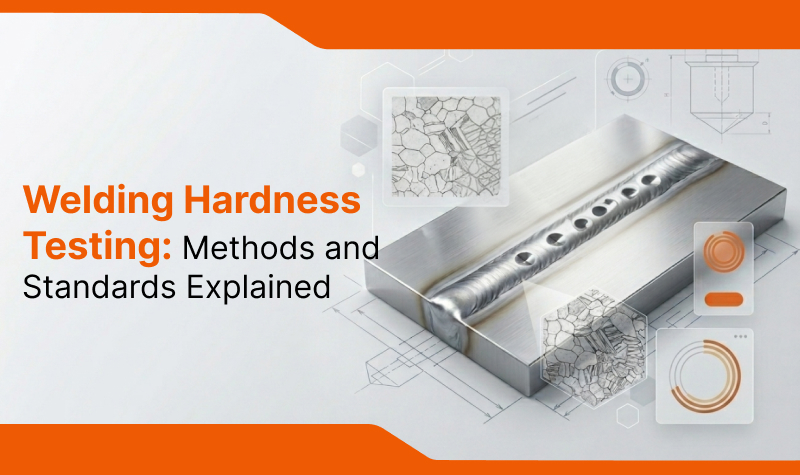
A welded joint can appear sound and still fail under service conditions if hardness is not properly controlled. Welding hardness testing plays a vital role in confirming whether a joint has the right balance of strength, ductility and resistance to cracking. It is a widely used quality control process that helps identify localised hard or soft zones created by intense welding heat and uneven cooling, conditions that may later lead to stress cracking, brittle fracture or reduced service life.
Across structural steelwork, stainless steel applications and pressure-bearing components, hardness testing provides measurable insight into how welding has altered material behaviour. When understood and applied correctly, it supports safer designs, predictable performance and consistent welding quality.
What Hardness Means in Welding
Hardness describes a material’s resistance to localised plastic deformation, assessed through indentation. In welded joints, hardness is not uniform because welding introduces rapid thermal cycles that alter microstructures across different regions of the joint.
Hardness evaluation generally focuses on three zones:
- Weld metal, formed by the deposited filler material
- Heat-affected zone, where base metal properties have changed due to welding heat
- Parent or base metal, which remains unaffected and serves as a reference
Excessively high hardness, especially in the heat-affected zone, is often associated with brittle microstructures and an increased risk of cracking. Low hardness, on the other hand, can reduce load-bearing capability and wear resistance. This is why hardness testing of welded joints focuses on hardness trends across zones rather than relying on a single value.
Why Hardness Testing is Important in Welding
Hardness testing supports welding quality at several levels:
- Confirms compliance with welding codes and engineering specifications
- Identifies susceptibility to cracking and brittle failure
- Supports welding procedure qualification and verification
- Assists in root-cause analysis during weld failure investigations
In routine welding work, the hardness test in welding also acts as an indicator of process stability. Consistent hardness results usually reflect controlled heat input, appropriate consumable selection and repeatable welding technique.
Common Hardness Testing Methods Used In Welding
Several standardized indentation methods are used to assess welded joints. The method selected depends on material thickness, weld geometry and the level of detail required.
Vickers Hardness Test (HV)
The Vickers method is widely accepted as the preferred hardness test for welding inspection. It uses a square-based diamond pyramid printer applied under a controlled load, commonly 5 kg or 10 kg for weld testing.
It is best suited for micro-hardness testing, heat-affected zones and thin materials. Its key advantage lies in precision, allowing indentations to be placed very close together, sometimes as near as 0.5 mm apart. This makes it ideal for mapping localised hardness changes across weld metal and adjacent zones.
Rockwell Hardness Test (HR)
Rockwell testing measures hardness based on indentation depth rather than size. It uses either a diamond cone or a hardened steel ball under minor and major loads.
This method is commonly used for thicker sections and in production environments where testing speed is important. Results are often reported on the Rockwell C scale for harder steels. While efficient, it offers lower resolution in narrow weld zones.
Brinell Hardness Test (HBW)
Brinell testing uses a large tungsten carbide ball pressed into the material under a heavy load. The resulting indentation is larger than those produced by the Vickers or Rockwell methods.
It is most suitable for thick parent materials, softer metals or components with non-uniform microstructures. Due to indentation size, it is rarely used directly within weld or heat-affected zones, but provides reliable average hardness values for base material assessment.
How is a Weld Hardness Test Carried Out?
A weld hardness test procedure follows a structured and controlled sequence:
- A representative weld sample is sectioned transversely to the joint.
- The test surface is ground and polished to remove scale, deformation and surface irregularities.
- Test locations are marked across the weld metal, heat-affected zone and parent metal according to the applicable standard.
- The selected hardness testing method is applied using calibrated equipment with specified load and dwell time.
- Indentations are spaced correctly to avoid interaction between readings.
- Results are recorded as individual values or as a hardness traverse across the joint.
- Measured values are compared against acceptance limits defined in codes or project specifications.
This systematic approach ensures that hardness measurements reflect true metallurgical behaviour rather than surface condition or testing error.
Key Zones Evaluated During Hardness Testing
A meaningful hardness assessment examines more than just the centre of the weld. To evaluate joint integrity accurately, testing is carried out across three critical areas:
- Weld Metal (WM): The fused filler material forming the joint
- Heat-Affected Zone (HAZ): The adjacent base metal altered by welding heat. This zone is often the most critical because rapid cooling can produce hard, brittle microstructures such as martensite
- Parent or Base Metal (BM): The original, unaffected metal used as a reference point
Understanding hardness variation across these zones helps determine whether the welding process has produced a balanced and serviceable joint.
Major Industry Standards Governing Hardness Testing
Hardness testing requirements are defined by recognised international and industry-specific standards to ensure safety, consistency and repeatability.
Commonly referenced standards include:
- ISO 9015: Destructive tests on welds in metallic materials – hardness testing
- ISO 22826: Hardness testing of narrow welded joints using micro-hardness methods
- AWS D1.1: Structural Welding Code for steel, including hardness requirements during procedure qualification
- ASME Section IX: Welding and brazing qualification rules for pressure equipment
- NACE MR0175 / ISO 15156: Specifies strict maximum hardness limits to prevent sulfide stress cracking in sour service environments
Always refer to project-specific documentation, as acceptance criteria and testing locations may vary based on material type and service conditions.
Consistency, Consumables and Hardness Control
While hardness testing confirms outcomes, achieving acceptable results depends on consistent welding inputs. Heat control, joint preparation and consumable quality all influence final hardness values.
At Superon Technik, we support consistent welding outcomes by supplying stainless steel fabrication consumables that deliver uniform performance across jobs. With dependable product quality, a one-country-one-price promise and easy availability across India, users can maintain stable welding procedures without frequent adjustments or sourcing challenges.
Conclusion
Welding hardness testing is a critical tool for verifying that welded joints can perform reliably under real service conditions. Identifying hard or soft zones created during welding helps prevent cracking, premature failure and costly rework. A clear understanding of testing methods, evaluated zones and applicable standards allows better control over weld quality and long-term performance. The next step is to review welding procedures, confirm hardness limits and align them with reliable consumables sourced from trusted welding electrodes manufacturers, ensuring consistent quality, compliance with project requirements and a dependable supply for uninterrupted welding operations.
Boost your weld quality today. Explore Superon Technik’s premium stainless steel consumables for consistent, reliable and high-performance results.
Learn how ProHance can help

Nikita Bhutani
With nearly 14 years of experience in the Learning and Development (L&D) sector, Nikita brings a wealth of knowledge and expertise to her role at ProHance. As the head of Content Strategy within the Growth & Demand Generation team, she plays a pivotal role in shaping the organization’s content initiatives. Nikita’s diverse background spans various industry segments, including BPO, IT, and BFSI, providing her with a deep understanding of the unique challenges each sector faces.
