



Eliminate Bench Risks and Boost Margins with ProHance Strategic Resource Planning
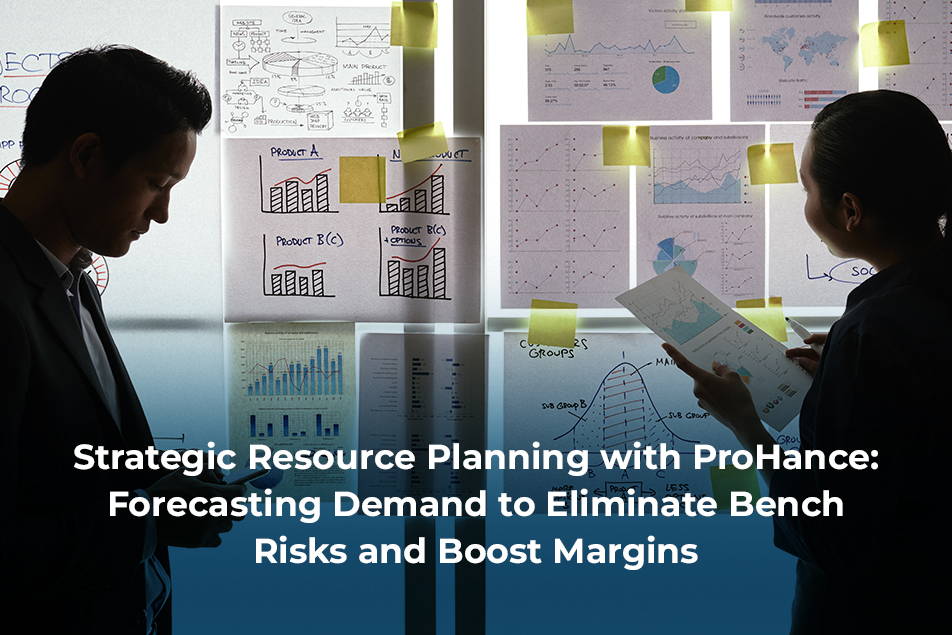
Resource planning is a critical component of business operations. Knowing how many people are required to meet demands at any point to fulfill tasks efficiently helps an enterprise manage costs and improve productivity. However, this is easier said than done. With fluctuating market needs and staffing changes, workforce demand forecasting can be challenging.
Many enterprises are turning to predictive analytics tools to understand workforce data and make insight-driven, data-backed hiring, retention, and other resource decisions.
Six Steps to Get Started on Resource Forecasting
Workforce demand forecasting requires careful planning and strategy. We’ve outlined six clear steps that will teach you the right techniques that will serve as a blueprint for designing your resource management strategy.
Step One
Study past projects and understand resource usage in your organization – staff, time, material, tools, and budgetary limitations. This historical data will give you a better idea of what you need for your current project.
Step Two
Once you have the data in hand, look for trends or patterns. Do you consistently over-allocate staff on certain types of projects, creating a shortage for other tasks? This underutilizes and wastes precious resources.
Step Three
Take a look at your current resource availability and identify specific skills within your project team. Allocate them to projects based on those skills to improve your overall performance.
Step Four
Apply techniques, such as capacity planning, scenario planning, and predictive analytics, to better forecast future resource demand. This will help prevent scenarios where you constantly over-allocate staff by encouraging you to make more conservative estimates based on actual hours required.
Step Five
Priorities can change based on fluctuating market demands. Being prepared with multiple resource scenarios keeps you agile and helps you adapt quickly.
Step Six
Demand forecasting isn’t a one-time activity. Collect feedback and consistently review your strategy to refine forecasts on a regular basis. Conducting these checks regularly will help you identify obstacles and roadblocks in real time, giving you the opportunity to switch gears when needed.
Key Challenges with Resource Planning
Realizing that resource forecasting can make your whole resource planning strategy run smoother is a great beginning. However, it comes with its own set of challenges. There are a few factors that can present some difficulties, making resource forecasting and allocation a little tricky. Knowing them and being prepared can help you avoid making avoidable mistakes. Let’s take a look at some common challenges.
Incomplete or Faulty Data
Workforce resource forecasting relies heavily on data analysis and the final output can be adversely impacted by incomplete or faulty data. Ensure that the data you use to create forecasts is of the highest quality, gathered in real time, and provides a complete picture of your resource needs.
Absence of Trained Teams
Automated resource planning software tools are quite beneficial in resource planning. However, the enterprise requires trained teams, and adopting the tools can be a learning curve.
Changing Project Priorities
Market fluctuations can lead to changes in project priorities, which can go on to create communication issues between stakeholders. Keep all parties in the loop and provide them with training to ensure you gather the latest, relevant data.
Non-standard Projects
In the absence of standard project types or structured project plans, it can be challenging to regularly gather data or identify trends needed to make accurate forecasts.
Workforce Forecasting Best Practices
While enterprises can encounter challenges during strategic resource forecasting, it is possible to achieve accurate workforce forecasts. What is needed is a well-planned organizational strategy that can help with predictive analytics. Here are four tips:
Determine the Purpose
Predictive analysis is beneficial for enterprises looking for more than just ways to reduce costs. Beyond cost savings, predictive analytics offers many benefits that provide organizations with expected key outcomes. Understand your exact needs to get the best results.
Address Pain Points
Not all issues and roadblocks are immediately obvious. Analytics and workforce forecasting tools can look deep into your operations and identify unseen problems. Once these challenges come to the forefront, enterprises can more readily prescribe the right solution.
Provide a Comprehensive Workforce Picture
Enterprise operations are impacted by data sources from inside and outside the organization. When forecasting, it’s essential to analyze both. Internal metrics cover employee attendance data, feedback surveys, and performance reviews. External sources include wage comparisons, benefits analyses, and market trends.
Emphasize the User Experience
Keep the end user in mind while using predictive analytics to support enterprise-level decision-making. Ensure data is collected in an appropriate, seamless, and straightforward manner. Further, collected data should be transparent and provide actionable insights for managers and team members.
Conclusion: Eliminate Bench Risks and Boost Margins with Workforce Planning
Human resource forecasting, while an undeniably critical element of enterprise success, is not an exact science. Workforce forecasting is necessary for businesses looking to remain competitive in the market space. With this reliable forecasting tool, an enterprise can make accurate resource predictions and estimations that ensure its operations remain seamless and productive.
To leverage the power of this tool, instead of using it as a reactive process, applying strategic resource planning best practices and using the right tools can give your enterprise a proactive advantage in today’s competitive landscape. You might be looking to fill immediate skills gaps or could be planning for future growth – by applying strategic workforce forecasting, you can ensure that your business always has the right people in the right roles at the right time.
With effective workforce forecasting, you can ensure your staff is effectively utilized, thus reducing the chance of benching and wasted resource risks. Busy and gainfully engaged employees are motivated, and you will observe reduced turnover.
At ProHance, we use data, technology, and collaboration, to help you anticipate your organization’s staffing needs, aligning them with your long-term business goals. With our resource planning tool, you will be empowered to build the most talented team for a project, ensure projects stay on schedule and within budgets, and confidently forecast and meet future business needs.
Connect with us to learn more about strategic resource planning.
Learn how ProHance can help

Anshul Jain
As Head of Marketing for ProHance, Anshul spearhead global marketing initiatives, championing product promotion, brand awareness, and engaging communications. He indulges his passion for writing, crafting captivating content that resonates with our audience whenever possible.
